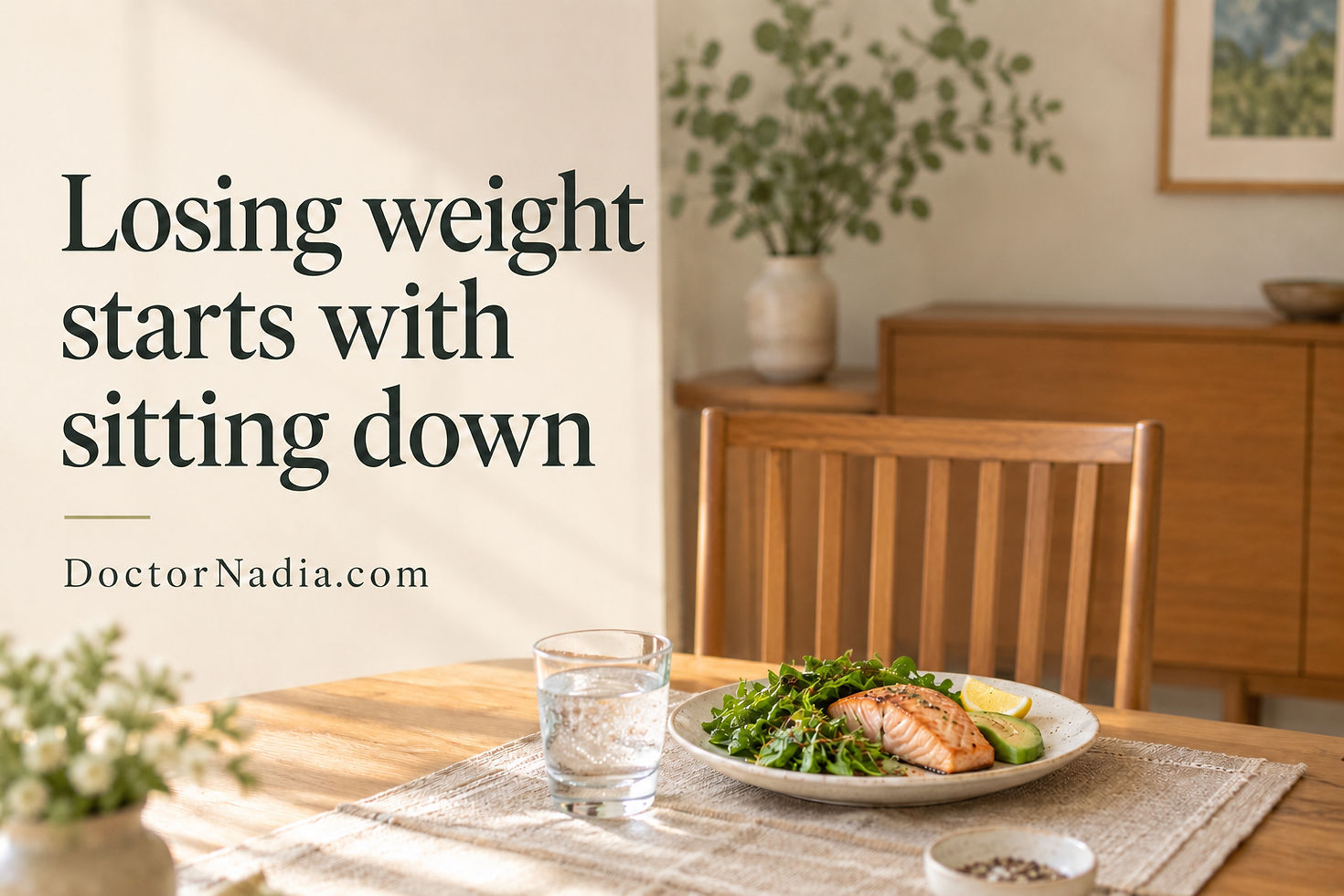
Losing weight is a lot simpler than you think. It starts with sitting down.
Losing weight is a lot simpler than you think. It starts with sitting down.
Simple does not mean easy. I want to say that up front, because if someone has spent years trying to lose weight, the last thing they need is another person telling them it should be easy.
I am talking about a first step so ordinary that we have almost stopped noticing when it disappears: sit down to eat a meal.
Not a bite while you answer an email. Not a snack in the car on the way to the next thing. Not a latte that you carry around and nurse all morning. A meal with an initial pause (more on this later), a beginning, and an end.
We have been talking about how we removed the traffic lights from eating. There used to be more obvious cues for when a meal started, when it finished, and what happened between meals. Those cues were never universal, and the past was not perfect. But in many homes and communities, eating had a time and a place. Remember how your grandparents were sitting at the dinning table at 5:01 pm (not 5:02 pm?!?). Now food can follow us everywhere, and we can eat without ever feeling that we have stopped to have a meal.
The day the movers stopped for lunch
When I first moved to Portugal, in 2018, I hired a moving company to bring our things into the new house. There were quite a few men working, so I ordered pizzas, snacks, and soft drinks. I thought they could grab something as they worked.
At noon, they looked at me as if I had a third eye. They were all going to lunch. Together. They would be back at two pm.
Their supervisor explained that they would sit down at the restaurant around the corner. Of course they would.
My Canadian brain could not wrap itself around it. They were going to stop moving my stuff to eat? In the version of work I was used to, perhaps one person would take a break while everyone else carried on. I had tried to make lunch convenient for them. They had planned to actually have lunch.
Years later, I still get caught out by this. There is a plant nursery near my house that I love visiting. More than once I have driven over at 1:30 p.m., found the gate closed, muttered a few choice words, and hit the steering wheel. Why does everyone have to stop at the same time to eat?
Then I remember why I value living here. In some small businesses, lunch is still treated as part of the day, not an interruption to it.
That is not every workplace in Portugal. Shopping centres, large chains, and many other businesses stay open while staff work shifts. Nor is every Portuguese person sitting down to a leisurely lunch. But those closed gates remind me that a shared mealtime can be protected if a community decides it matters.
How eating became something we do while doing everything else
This did not happen because women started working and somehow broke the family meal. Women have always worked, paid and unpaid, and the responsibility for feeding families has too often fallen on them. As more women worked outside the home, that responsibility did not simply disappear. Convenience foods offered a practical answer to a real demand for time and help. TV dinners were on the market in the 1950s, and food manufacturers kept finding new ways to make food quick to prepare, easy to store, and easy to take along. [1, 2]
Many of those changes helped people. I use convenient foods too. The problem is the wider habit we have built around constant availability: eating while driving, shopping, scrolling, or working; carrying a drink that is effectively a long, drawn-out snack; treating a proper lunch break as a luxury.
We can spend enormous energy asking what we should eat and barely ask how we eat. We compare ingredients and macros while finishing lunch at our desks without noticing that we have eaten it.
Of course, a seated meal does not automatically lead to weight loss. Weight, blood sugar, fertility, skin, and appetite are influenced by many things, including biology, hormones, medication, stress, sleep, access to food, and the demands of daily life. I would never ask someone to solve a complex medical concern with a chair.
But sitting down can give us a useful starting point. It marks an occasion: I am eating now. It lets us pay attention to the food, our appetite, and the moment we are finished. Research on distracted eating suggests that attention during meals can influence how much people eat, although the findings vary by setting. It is a reason to be curious about our own eating patterns, not a promise that sitting down will change a number on the scale. [3]
Sit. Pause. Eat. End.
Before changing your diet, try changing one meal. Pick a time and a place where you can sit. Put your food on a plate if you can. Pause for a moment before the first bite. Eat the meal. When it is over, let it be over.
That is the beginning of Sit. Pause. Eat. End. It gives the meal a shape. From there, we can start to notice the space between meals—what I call Meal. Gap. Meal. These are ways of restoring a little guidance to the day, like putting traffic lights back at an intersection.
If you grew up eating at the table, you may suddenly realize how far your adult life has drifted from that pattern. If you did not, you are not behind. You can build a mealtime that works in your own home and circumstances. It need not be a two-hour restaurant lunch or a family gathered around a perfect table.
It might be ten minutes away from your desk. It might mean telling your workplace you are taking the lunch break you are entitled to. It might mean packing an actual meal for a shift, or sitting down with your coffee rather than carrying it from task to task.
And yes, that can be inconvenient. It can mean planning ahead, setting a reminder, changing a routine, asking for help, or stopping something important because it is time to eat. Some people have very little control over their breaks; that deserves practical support, not a lecture about priorities.
When I say losing weight is simpler than you think, I do not mean your body is simple or that this one habit will fix everything. I mean that the first step may come before another food rule. We can begin by making room in the day to eat a meal—and to know when that meal is done.
This week, choose one meal a day and try it: Sit. Pause. Eat. End. Notice what feels different, what gets in the way, and what you would need to make it possible again tomorrow. That is where we start.
Sources and further reading
1. Smithsonian National Museum of American History, “Swanson TV Dinner Tray”.
2. Smithsonian National Museum of American History, “Postwar potluck: Grilling out, convenience cooking, and other 1950s food trends”.
3. “Eating while distracted: a systematic review and meta-analysis of the effect of distraction on concurrent and later energy intake in adults,” The American Journal of Clinical Nutrition (2026).


Comments